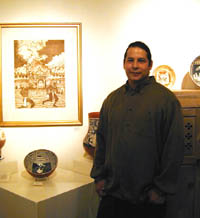
Meet Diego Romero
New Etchings Etchings Ceramics Ceramics2 Available Ceramics Available Etchings

Diego Romero uses traditional Pueblo Indian shapes when he builds his pottery, yet he decorates his work with a cross-cultural mix that uses modern imagery to depict both traditional and contemporary Indian culture. Romero's pots tend to make statements, often political, about contemporary Indian life. In his imagery, he uses the stylized heads often seen on burial bowls from the prehistoric Southwestern Mimbres culture. At first he adapted actual Mimbres images into his work.

Diego makes both jars and bowls, although he is best known for the latter. The jars are true labors of love because they are so time consuming to make and decorate. He has only recently produced the series of etchings, using adaptations of images from bowls.

Diego refers to his style as "definitely cartoony or comic book", but the distinctive result is his way of relating the contemporary to the ancient. Ideas for his decorations come from life experiences. Diego's participation in traditional races at Cochiti resulted in a design with a runner having a muscular body from a Greek amphora and a head with hair tied in a knot at the back, or chongo, from a Mimbres bowl. Because he was often in a car traveling between Santa Fe and California, Diego depicted humorous situations involving the automobile, resulting in the "The American Highway" series, that often included "The Chongo Boys", "Indian Girl", and "Coyote". More recently he has begun to depict historical events on his work.

Diego Romero's background, like the designs on his pottery, is cross cultural. His father, Santiago Romero, was a traditional painter from Cochiti Pueblo. Diego, like his mother, was born and raised in Berkeley. After art school in California he attended The Institute of American Indian Art in Santa Fe, where , he recalls, "I really had an interest in [ceramics] right from the start". Shortly after graduating from IAIA he enrolled at Otis Parsons School of Design in Los Angeles. He moved on to UCLA, where he received his MFA in 1993. Diego now lives and works in New Mexico.

Diego's pots are as cross cultural as their decoration and their maker. He combines traditional native materials and techniques with contemporary commercial potter's supplies and methods to produce the effects he desires "..if I want a certain desired effect then I'll go for the material that produces that effect. When you are doing native pottery there are certain qualities that you just don't get with commercial products. I don't have a problem with using commercial materials ... I mix them up and I use what I need to get the effect I want."

Diego sums up his work, saying "I think that I have developed a narrative and a voice. I'm really happy with what I do now. I really take pride in my work and I like the fact that they are these little cartoony, political, comics on bowls and that I can make fun and comment on the history of the Pueblo people at the same time."